Coronal Forbidden Lines During Total Solar Eclipse
The visible solar disk is hundreds of thousands of times brighter than the Sun's outer atmosphere, the corona. Therefore, our ancestors and early scientists could observe the corona only during total solar eclipses, when the Moon completely blocks the light from the solar disk. Although the invention of the coronagraph (which uses an occulter to block the disk) and spaceborne telescopes now allow routine observations of the corona, total solar eclipses remain among the best opportunities to observe faint structures in the solar corona.
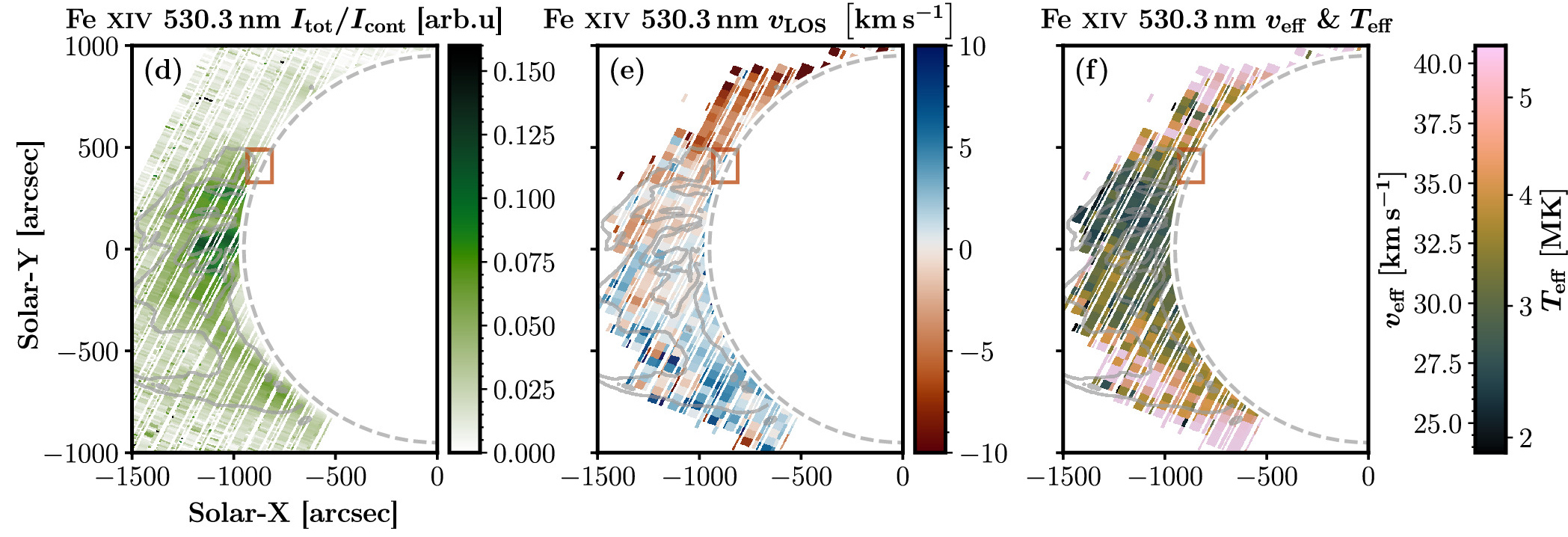
The Fe xiv line at 530.3 nm, emitted by iron ions that have lost 13 of their 26 electrons, was first observed during the 1869 total solar eclipse (Young 1869; Harkness 1970). Its emission was initially attributed to a new element named coronium after the corona. However, Grotrian (1939) and Edlén (1943) later identified it as Fe xiv, providing the first direct evidence that the solar corona contains million-degree plasma. We analyzed spectroscopic observations of the Fe xiv green line and the Fe x red line at 637.4 nm to study bulk plasma motions, ion heating, and wave dissipation across a large field of view in the lower corona. The observations were made by the Solar Wind Sherpas team, led by Dr. Shadia Habbal. See Zhu et al. (2024) for more details.
Ion Temperatures and Preferential Heating
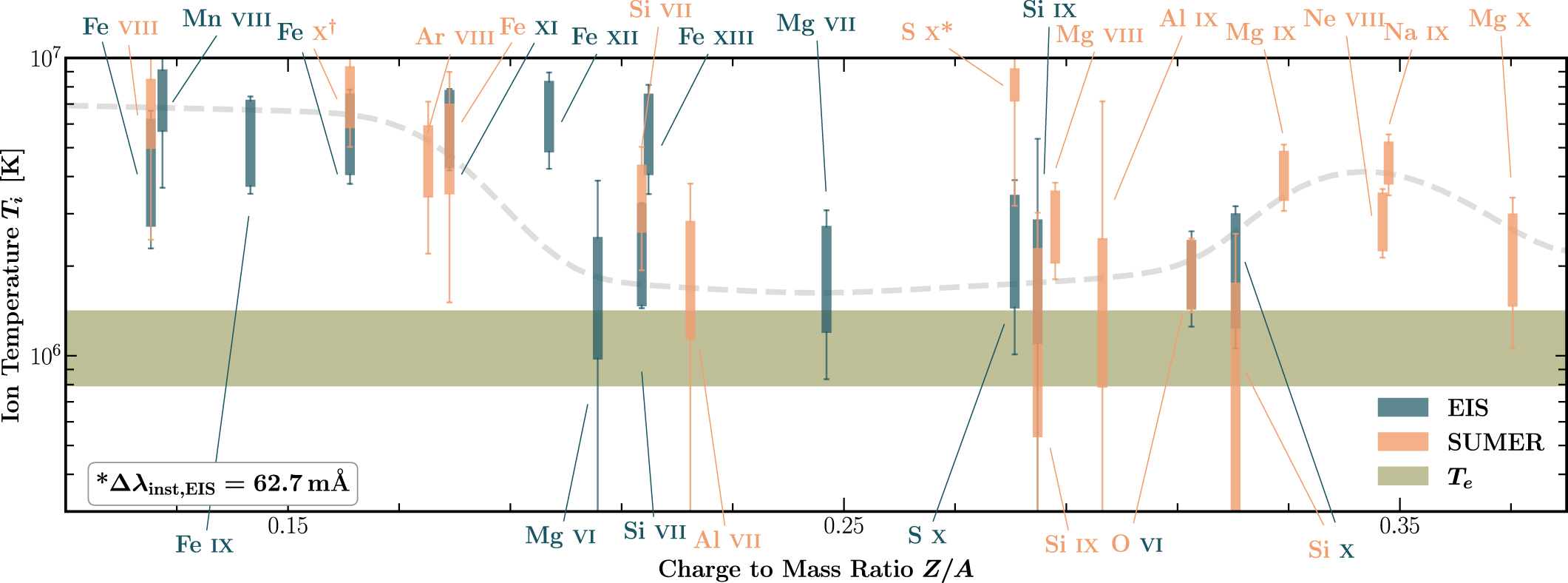
Although more than 98% of the mass of the solar atmosphere consists of hydrogen and helium, heavy ions (elements with atomic numbers greater than 2, also called “metals”) play important roles in coronal physics. For example, emission from highly ionized heavy ions at extreme-ultraviolet wavelengths results in substantial radiative losses and provides key diagnostics of coronal density and temperature. Additionally, differences in charge-to-mass ratio allow heavy-ion species to resonate with plasma waves or turbulence at various frequencies, resulting in additional heating and temperature anisotropy through a process known as ion-cyclotron resonance. We investigate the preferential heating of heavy ions with different charge-to-mass ratios. We found that heavy-ion temperatures in coronal holes show a nonmonotonic dependence on their charge-to-mass ratios. See Zhu et al. (2023) for more details.
Solar flares and Mg II spectra
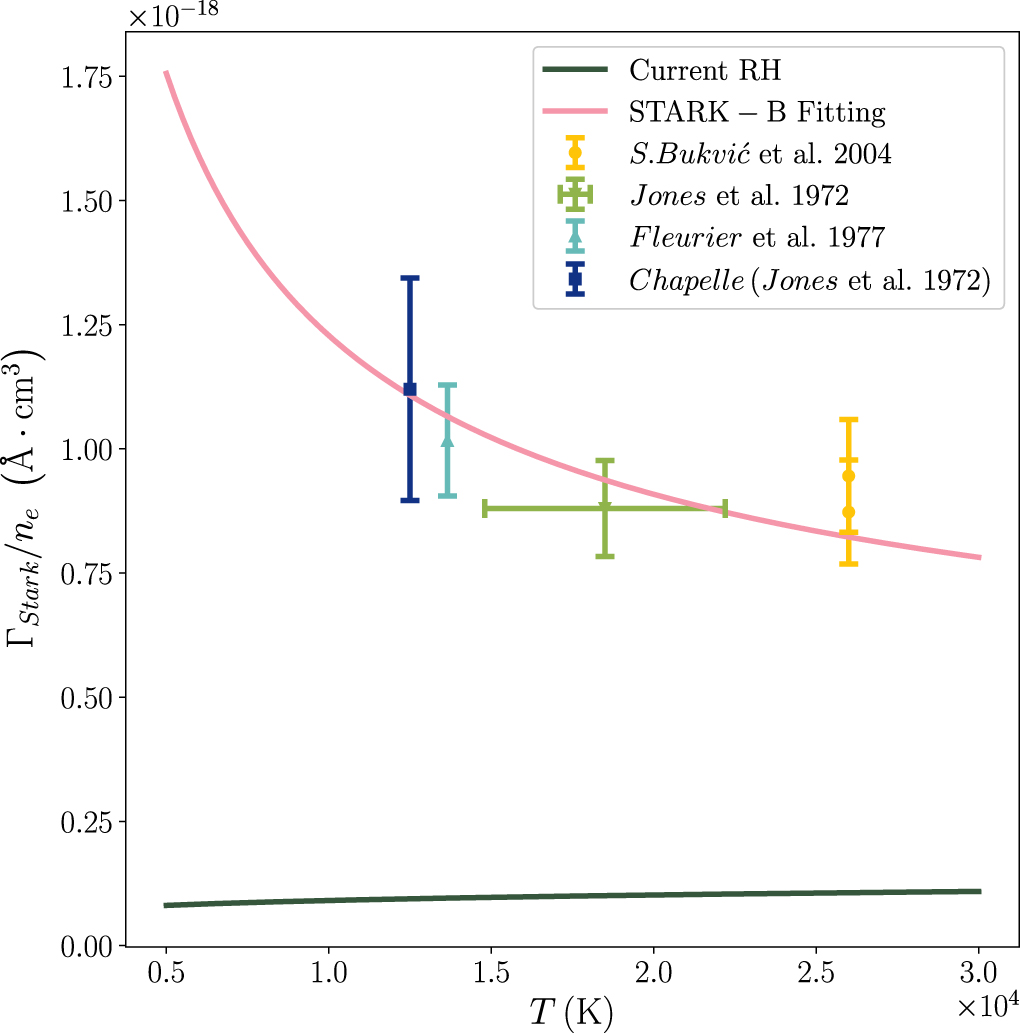
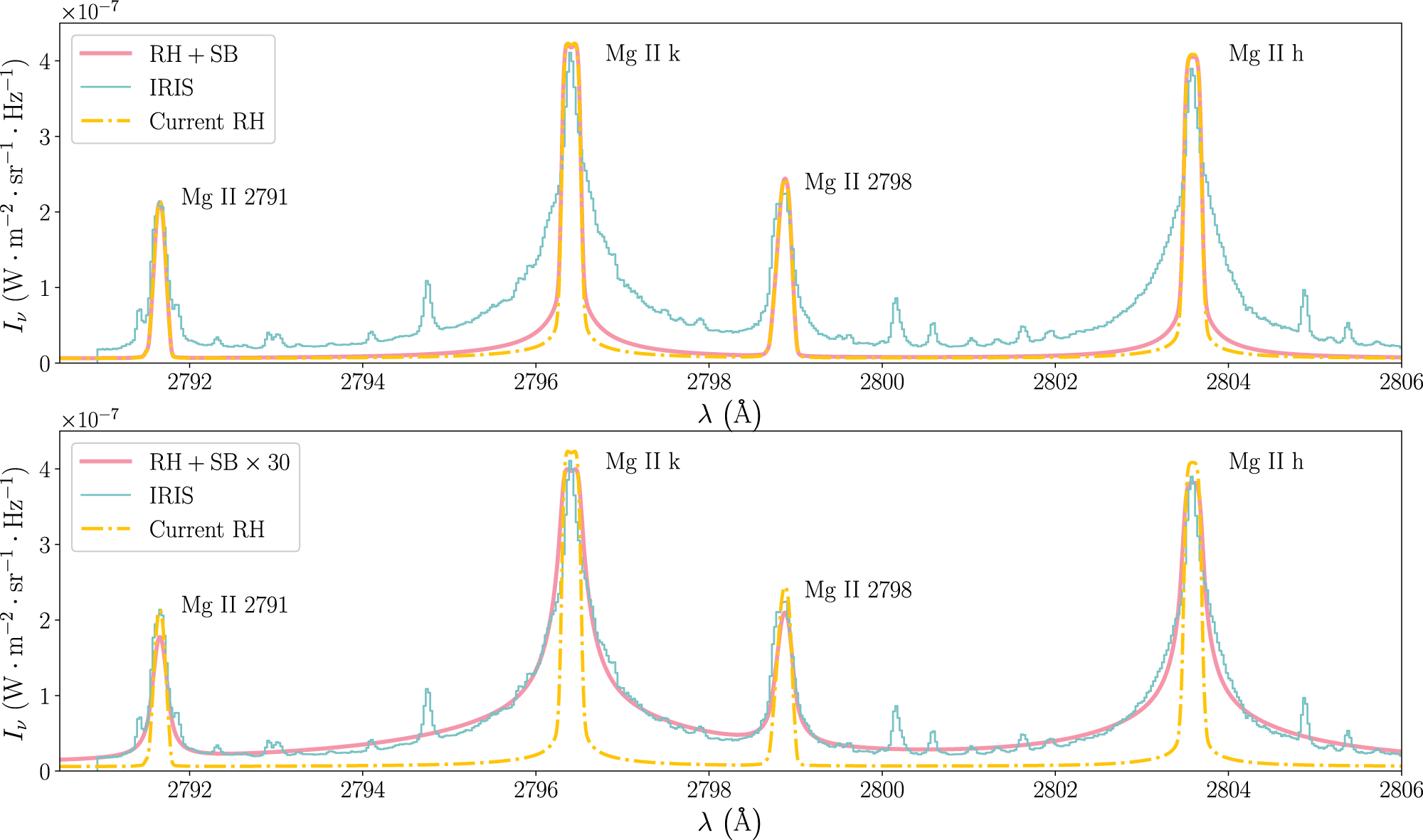
Solar flares convert magnetic energy into heat, plasma motion, and radiation, while also accelerating energetic particles. I use radiative-hydrodynamic simulations together with observations to study how flare energy is deposited in the lower solar atmosphere and how this energy shapes the Mg ii spectral line profiles at the energy deposition sites known as flare ribbons. We found that previous simulations underestimate the spectral-line broadening caused by electron pressure (the Stark effect). However, an ad hoc factor of 30 is required to fully reproduce the observed profiles. See more in Zhu et al. (2019).